Every bar has an address. Ours happens to sit on one of the oldest streets in Vilnius, a narrow run of cobblestone named, plainly, for the people who once made glass here. Stiklių gatvė. Glassmakers' Street. We pour drinks into glass on a street that was named for it, which is either a coincidence or the kind of small joke a city keeps for five hundred years.
A street named for glass
Stiklius is the old Lithuanian word for a glazier, a maker and setter of glass. The first glass manufactory in the Grand Duchy of Lithuania was founded in this quarter in 1547, and at its height the district held three separate Glass Streets. The goldsmiths kept their guild here from 1495; the Jewish quarter grew up alongside it. This is the old craftsmen's heart of the Old Town, narrow, cobbled, and crooked in the way only medieval streets are. Cars give up halfway down it. People slow down.
The view from number 4
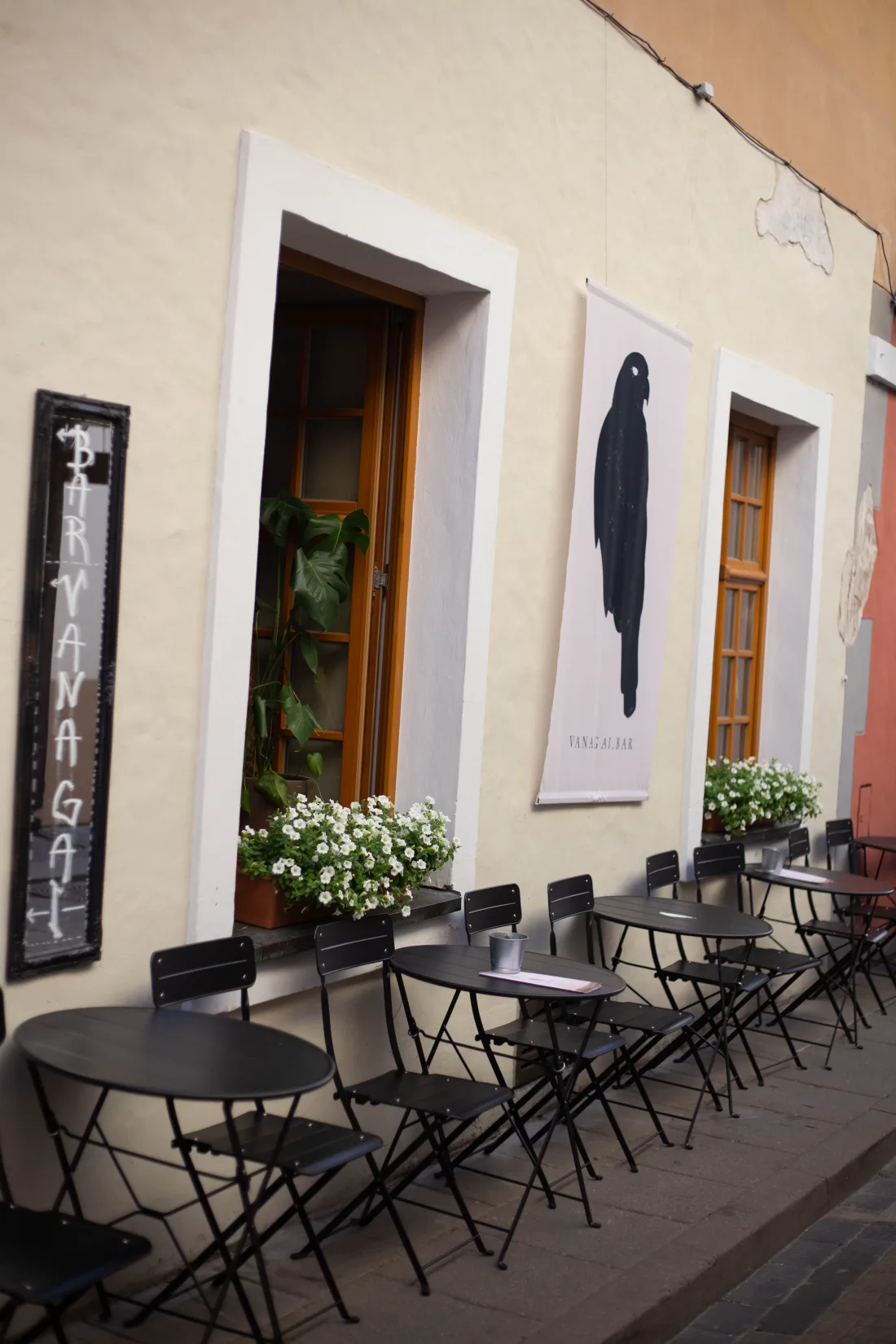
We are at Stiklių g. 4. From the terrace the street does most of the work, pale stone facades, the lean of old walls, light that turns amber an hour before closing. Inside, the windows frame the same view in a darker key, the warm light of the room, and the street going about its evening on the other side of the glass. It is a good street to sit on and a better one to watch. In summer the chairs go out; in winter you take the window seat and let the cold stay where it is.
Medeinė
Number 4 does not stand alone. Step into the courtyard at number 6 and you find Medeinė, the old Baltic goddess of forests and the hunt, cast in bronze and riding a bear. She has kept that courtyard since 1988. We named the bar Vanagai, hawks, and put the forest in the glass: pine, berry, herb, bark. A goddess of the woods and the hunt, a few steps from the door, feels less like decoration and more like permission.
The first book
The other figure keeps a longer memory, in pink granite: a man seated with a book open on his knees. People call him the Annalist, though the name is half an accident, he was carved and set down in the Soviet years without permission, and with no one willing to say whom he honoured, the neutral title stuck. What he marks is real enough. A printing house stood at number 4, and it is believed the first book in this land was printed on this spot in 1522, the work of Pranciškus Skorina, in old Ruthenian, four centuries before the bar. Glass and ink on one short street. A bar keeps its own kind of record too, of evenings, of people who met here once and never again, of the one good conversation you only half remember.
Come sit on it
You do not need a reason to walk down Stiklių gatvė, but here is one. Find the glassmakers' street, find the goddess on her bear and the man with his book. Take the terrace if it is warm, the window if it is not. The drinks are Lithuanian and so is the street; the full menu is here.
If you are looking for a cocktail bar in Vilnius Old Town that drinks like the place it is from, Stiklių g. 4 is the address, easy to find, and hard to leave. The room is also one you can take for a private event.